
Drought-Tolerant Plants for Tbilisi Gardens — A Complete List
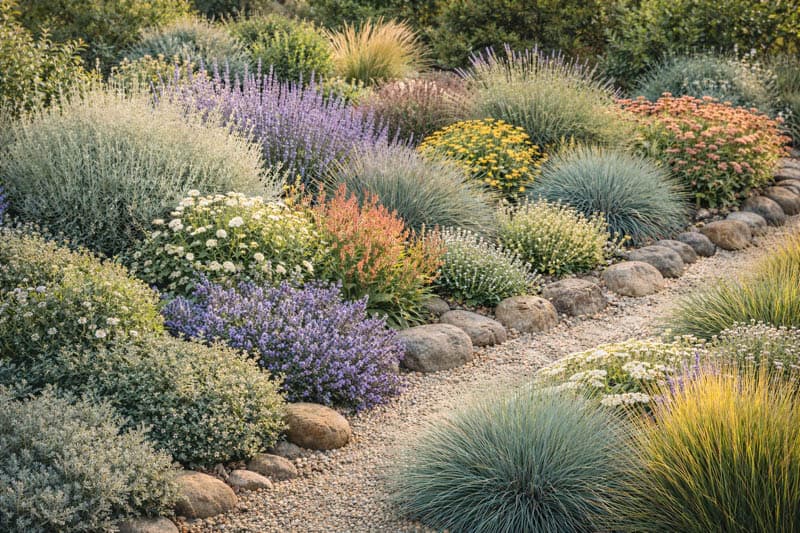
Tbilisi summers are not what they were twenty years ago. In July and August the temperature regularly reaches +38 °C, while rainfall across those two months often fails to add up to 30 mm. A garden that depends on daily watering either costs a fortune in those conditions or simply wilts. The fix is straightforward: choose plants that already like Tbilisi's climate.
Why drought tolerance matters here
- Water cost. An average yard (300 m²) needs 1,500–2,500 litres a day in summer if the planting was chosen badly.
- Sun and wind. On Tbilisi's slopes soil dries twice as fast — hot sun and dry wind compound each other.
- Soil. Most city gardens sit on clay-limestone soil (pH above 7.5), which holds water poorly and compacts quickly.
- Holidays. Two weeks away in August shouldn't mean coming home to a scorched yard.
What "drought-tolerant" actually means
Drought-tolerant does not mean "needs no water at all". Every newly planted specimen needs regular watering for the first one to two years, until its root system goes deep. After that, the species below get through a Tbilisi summer on one deep soak a week — and some on nothing at all.
Two practical rules:
- Plant in autumn (October–November), not in June. Roots develop over winter and spring, so the plant meets its first hot season already established.
- Water rarely but deeply — 30–40 litres per tree once a week instead of a daily surface sprinkle. Shallow watering pulls roots upward and makes the plant permanently dependent.
Trees for a dry yard
- Olive (Olea europaea) — silver foliage, hardy to about −12 °C. Winters well in the Tbilisi lowlands; needs shelter on exposed slopes.
- Pomegranate (Punica granatum) — ornamental and productive at once: orange June flowers, autumn fruit, minimal care.
- Judas tree (Cercis siliquastrum) — the whole trunk breaks into pink flower in spring. Grows in poor, stony ground.
- Southern hackberry (Celtis australis) — a substantial shade tree, proven in Tbilisi yards for decades.
- Almond (Prunus dulcis) — early blossom, low water demand, a good choice for a small yard.
- Italian cypress (Cupressus sempervirens) — a vertical accent and windbreak that needs virtually no water once established.
Shrubs that don't complain about summer
- Lavender (Lavandula angustifolia) — the classic of dry, sunny ground. Demands good drainage; wet feet kill it faster than drought.
- Rosemary (Salvia rosmarinus) — evergreen, aromatic, useful in the kitchen. Works well as a low border.
- Juniper (Juniperus) — horizontal forms hold a slope; upright forms make a hedge.
- Smoke bush (Cotinus coggygria) — purple-red foliage and smoky flower plumes. Native to the Caucasus, so a genuinely local choice.
- Barberry (Berberis thunbergii) — thorny and colour-leaved, useful for a defensive hedge.
- Tamarisk (Tamarix) — tolerates saline and poor soil, ideal as a windbreak.
- Russian sage (Perovskia atriplicifolia) — silver stems and violet flower from July to September with near-zero maintenance.
Perennials and ground covers
Replacing part of the lawn with ground cover produces the single largest saving — lawn is the thirstiest element in any yard.
- Sedum (Sedum) — stores water in fleshy leaves and holds up in full sun.
- Creeping thyme (Thymus serpyllum) — a low, fragrant carpet between paving stones; tolerates light foot traffic.
- Yarrow (Achillea millefolium) — a local perennial that flowers all summer.
- Santolina (Santolina chamaecyparissus) — silver cushions, ideal for a gravel garden.
- Lamb's ear (Stachys byzantina) — soft, felted leaves that naturally cut evaporation.
- Ornamental grasses — blue fescue (Festuca glauca) and Mexican feather grass (Stipa tenuissima) add movement and texture on minimal water.
Six rules that make any garden drought-resilient
- Mulch everything. A 5–7 cm layer of bark or compost cuts evaporation by 60–70% and suppresses weeds.
- Group by water demand. Thirsty plants in one zone, drought-tolerant ones in another — so you no longer over-water the whole garden for the sake of one specimen.
- Drip irrigation on a timer. 30–50% less water than sprinklers and minimal evaporation loss. Details here: drip irrigation in agriculture.
- Organic matter in the soil. Compost worked in once a year raises the water-holding capacity of clay soil.
- Shrink the lawn. Replacing half the lawn with ground cover or a gravel garden nearly halves summer water use.
- Plant for shade. One tree on the south-west side of the yard sharply reduces the water demand of everything beneath it.
How much water and money you save
A properly composed drought-tolerant garden cuts summer water consumption on a 300 m² yard by roughly 40–60%. Add to that less mowing, less fertilizer, and fewer dead plants to replace — a few hundred GEL a season, and a garden that still looks good in August.
Where to start
Start with a soil and light assessment, and only then choose plants. The Dr. VERDE team handles plant supply and planting across Tbilisi and the metro area with a 12-month guarantee, while automatic irrigation systems sets up drip lines and a controller so every litre reaches the roots.
For an established yard, seasonal agrotechnical works covers mulching, soil improvement, and autumn planting, and the yard care subscription keeps it maintained year-round at a fixed monthly price.
Get in touch for a free consultation — we visit the site, assess soil and light, and give you a concrete list of the plants that will actually work in your yard.