
Vermiculite and Perlite — Which One to Use, and in What Proportion
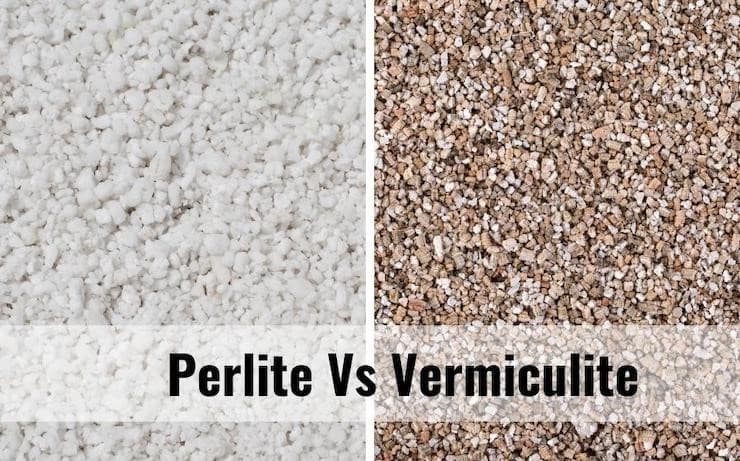
Vermiculite holds water and nutrients; perlite lets water drain away. Use vermiculite in seed trays and for moisture-hungry transplants, and perlite in container mixes, for cuttings, and for lavender, olive and other Mediterranean plants. Neither one fixes a heavy Tbilisi clay yard — dug into clay, vermiculite makes waterlogging worse.
The difference in one line
Both are minerals blasted with heat until they puff up, and both are light, sterile and roughly pH-neutral. That is where the similarity ends.
- Vermiculite is expanded mica. It is spongy: it holds water inside itself, and it holds nutrients too. It has real cation exchange capacity, which means it grabs potassium, magnesium and ammonium as you feed, then releases them back to the roots slowly. It also carries a little magnesium and potassium of its own.
- Perlite is expanded volcanic glass. It holds almost no water internally. What it does is hold open air pockets between soil particles, so surplus water drains through and roots keep getting oxygen.
So the question is never which one is better. It is: does this particular mix need to hold more water, or lose more water?
Where vermiculite earns its place
Seed starting. This is its best use by far. Mix roughly one part vermiculite into two or three parts of seed compost, and the mix stays evenly damp between waterings instead of swinging from soaked to bone dry. That swing is what kills seedlings.
As a covering layer over sown seed. Sift a thin layer — a few millimetres — over the surface after sowing. It lets light through, keeps the seed in contact with moisture, and stops the surface crusting. Crusting matters here more than in most places: potting mixes blended with local Tbilisi topsoil set into a hard cap after two or three waterings, and small seed cannot push through it.
Transplants and moisture-lovers. A handful in the planting hole helps anything that sulks when it dries out — hydrangea above all. If yours is struggling, the hydrangea care notes cover the rest of the picture.
Greenhouse substrate. In a tunnel or glasshouse, evaporation is high and hand-watering is uneven, so a water-buffering component pays for itself. We normally specify it in the substrate when we plan a greenhouse build.
Where perlite is the right choice
Container mixes. Around 20–25% perlite by volume in a pot mix is a sound default. Pots have no subsoil to drain into, so without an aerating component the bottom third stays saturated and roots rot there first.
Cuttings and propagation. Roughly half perlite, half peat is the classic rooting mix. You want air around a cut stem, not a wet sponge.
Anything Mediterranean or drought-adapted. Lavender, rosemary, olive, juniper, most succulents. These plants die of wet feet far more often than of thirst in Georgian gardens — our olive tree guide goes into why. Vermiculite in these mixes is actively harmful.
A pot that has gone sour. If the soil is wet, the plant is wilting anyway, and the pot smells stale, the problem is air, not water. Repot with more perlite.
Why neither one fixes a Tbilisi clay yard
This is the question we are asked most often, and the answer disappoints people: do not buy bags of vermiculite to improve a clay bed.
Tbilisi and the surrounding districts sit on clay-limestone parent rock. The soil is heavy, slow to drain, and usually above pH 7.5. Adding a water-holding sponge to soil whose actual problem is that water already sits in it makes winter waterlogging worse, not better.
Perlite is the right kind of material for that job, but the arithmetic defeats it. To change the structure of a clay bed you would need it at something like a quarter to a third of the topsoil volume — for a modest 20 m² bed worked to 25 cm deep, that is thousands of litres. At the shop price of a 10-litre bag, the bill is absurd. It is the same volume arithmetic that makes adding sand to clay a waste of money.
What actually shifts heavy clay is organic matter and gypsum, applied over several seasons. That is a different job with a different method, and we set it out step by step in the guide to improving clay and alkaline soil.
One more expectation to correct: vermiculite will not acidify anything. It is neutral to slightly alkaline, so it cannot lower a pH that is already 7.5 or higher. If you need acid conditions — hydrangea, azalea, blueberry — that comes from peat and sulphur, not from vermiculite. Before you spend anything on amendments, a soil analysis is worth more than the amendments themselves, because two neighbouring yards in a new development often test completely differently.
For a lawn, neither material belongs in the seedbed at scale. Levelling, screened topsoil and proper preparation decide the result, which is why we handle it as part of lawn installation rather than as a bag of additive.
What to buy, and how much
At our shop prices at the time of writing, a 10-litre bag of vermiculite is 20 GEL and a 10-litre bag of perlite is 18 GEL, with 80 litres of peat at 28 GEL and a 25 kg coarse sand mix at 12 GEL.
To size it: one 10-litre bag of vermiculite blended at one part in three gives you about 40 litres of seed-starting mix. A standard seed tray filled 5 cm deep takes roughly 3.5 litres, so that is around ten to twelve trays — a full season of sowing for most home growers.
The simple rule: buy perlite if you are filling pots, vermiculite if you are sowing seed. One bag of each per season covers a normal household.
Both are dusty when dry, and that dust is not good to breathe. Dampen the bag before you mix, or wear a mask. Store them dry and they keep indefinitely — and both can be washed and reused from old potting soil, which is worth doing with perlite in particular.
Frequently asked questions
Not interchangeably — they do opposite jobs. Vermiculite holds water in the mix; perlite lets water out of it. Swapping perlite for vermiculite in a pot of lavender or an olive in a container is one of the most common ways those plants are killed here, because the mix then stays wet exactly where it needs to stay airy.
Neither, at any meaningful scale. A lawn seedbed is decided by levelling, screened topsoil and compaction control, not by a bag of mineral additive — the volumes involved would cost more than the lawn. Vermiculite is useful on a lawn only in one narrow case: a very thin sifting over patch-repair seed to stop the surface drying out.
No. Vermiculite is neutral to slightly alkaline, so it cannot bring down a pH that already sits above 7.5, as most Tbilisi soil does. Acid conditions for hydrangea, azalea or blueberry come from peat and elemental sulphur, and in open ground the free lime in the soil will keep pushing the pH back up, so the treatment has to be repeated.
Yes, and it is worth doing with perlite, which is chemically inert and survives indefinitely. Sieve it out of the spent compost, rinse it and let it dry. Vermiculite is softer and gradually crushes down under repeated use, losing the open structure that made it useful, so expect to replace it more often.
Related services
- Seasonal Agrotechnical WorksGrass mowing, tree and shrub pruning and shaping, disease and pest control, soil analyses, and other seasonal works.
- Greenhouse Design and ConstructionServices from consultation to a fully commissioned project — greenhouse design, construction, annual planning, and management.
- Premium-Quality Lawn InstallationLawn seeding, care, and rehabilitation. Premium rolled-sod installation on any terrain and at any location.